
The Indian Spring represented by Anna Hazare's anti-corruption campaign, which has culminated in the Aam Aadmi Party's impressive electoral debut in New Delhi, began around the same time as the Arab Spring in 2011 but they led to different outcomes in India and the Arab world, says Ramesh Ramachandran.

'By beheading an Indian soldier, the Pakistan army has demonstrated its proclivity for barbaric medievalism.' 'The strategies adopted and the punishment inflicted by India must be made progressively more stringent with every new act of terrorism till the cost becomes prohibitive for Pakistan,' says Brigadier Gurmeet Kanwal (retd).

The Nobel Prize for Malala may have caused deep divisions across the globe and disturbed the peace, while the award to OPCW, though not without critics, may have served the cause of peace by eliminating a weapon of mass destruction from the face of the earth, says Ambassador T P Sreenivasan.
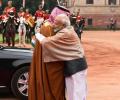
PM Modi also called for a strong action plan for combating extremism.

"We are committed to building a new India. We have to do this as early as possible," he said.

'The challenges of the world are too great for any one religious tradition to address alone... The best way to learn about other religions is not from books, but from people... Go talk to someone from a different faith tradition. Get to know them. Build up some trust.' Dr Katharine Rhodes Henderson, who jointly won Hofstra University's Guru Nanak Prize for inter-faith champions in the United States, discusses religion and the challenges of extremism in this lively interview with Rediff.com's Arthur J Pais.

'The present government's greatest weakness is its intolerance. Tolerance is the key tenet of democracy. How can any government stop someone from speaking one's mind?'
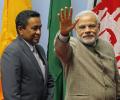
'Now is the time for India, our biggest neighbour and oldest friend, to bring the full array of international policy instruments to bear.'

Noting that oil prices had gone down after the BJP-led government came to power in May 2014, before they went up, Prasad said it is a problem whose solution is not in its hands.

'Jaish aided by LeT attacked Parliament knowing mobilisation of Indian military assets would be the consequence.' 'That mobilisation happened, necessitating a military response from Musharraf who moved troops guarding back doors out of Tora Bora, facilitating Osama's escape.'

North Korea is unlikely to strike first, but its response in retaliation, if attacked, could be massive even at the expense of its own destruction, says Rajaram Panda.

Indians want change and progress. They should be willing to accept tough decisions, says Sanjeev Nayyar.

'This is the first time that the Americans have agreed to refer to "cross-border terrorist attacks" in a joint statement.' 'No wonder Pakistan has called the joint statement "singularly unhelpful" and has blasted it, and its all-weather friend China has applauded Pakistan's frontline role in combating terrorism,' points out former foreign secretary Ambassador Kanwal Sibal.

Rahul Gandhi has taken the fight to the Modi government, feels Milan Vaishnav. Aziz Haniffa/Rediff.com reports from Washington, DC.

For more than half of all Indian households, the very personal act of defecation is an open affair, says Joel Rai
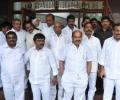
Three ministers from Andhra-Rayalaseema regions submitted their resignations to Chief Minister N Kiran Kumar Reddy late on Thursday night even as at least 15 others are understood to have backed out following a stern warning by the high command.

Union Home Minister Rajnath Singh declared that there is no question of handing over Kashmir to the Army, quashing rumours that are being spread 'deliberately'.

Awful religious practices need to be abolished. But through social and political reformers, not by courts, argues Shekhar Gupta.

The people who know Tibet will continue to fight the good fight. Long, hard, less than hopeful, but always peaceful.
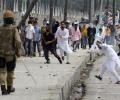
Kashmiris hope that India and Pakistan can find a lasting solution to what many call the Kashmir 'problem'.

'I felt like a used and discarded rag.' 'The pro-dialogue constituency has shrunk in the valley.' Academician and author Dr Radha Kumar was among the three interlocutors which the Manmohan Singh-led UPA government appointed on Kashmir in October 2010, speaks of how the panel report was never acted upon.
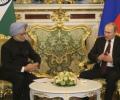
In a clear attempt to allay Russia's apprehensions, Prime Minister Manmohan Singh on Monday said it will remain an "indispensable" partner for India's defence needs even as he underlined that the bilateral ties should adapt to changing times to address challenges.

A 'soft' approach must be nurtured to complement the hard-line of spending billions in physical conflict; that is the only way to 'degrade and destroy' ISIS.

'The government has to take effective steps to strengthen democracy, rule of law, maintain communal harmony and safeguard the security of the country and its people.' 'The government has to carry all sections of the people with it irrespective of their race, caste, community, region or language,' and try to unite them by promoting fraternity among them,' says legendary Constitution expert P P Rao.
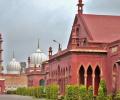
'AMU is a secular university with an Islamic ethos.' 'We do not discriminate on the basis of religion. Let me tell you Muslims do not need reservations. They need affirmative action in education.'

'If the museum in his memory inspires and instils among Brahminical British Indians an attitude of equality towards Dalits, the edifice would be worth it,' reports Ashis Ray.

India's demographic dividend may not automatically give rise to tangible economic gains -- at least not with immediate effect -- but it is likely to have a big impact on the coming Lok Sabha elections, Mayank Mishra

'What gives hope is that Modi's own leadership is vitally linked to his capacity to deliver on the economic front. Indeed, if he succeeds, India's foreign policies will have changed beyond recognition,' feels Ambassador M K Bhadrakumar.

Rohith, like Mahatma Gandhi, was not allowed to speak the truth by the forces who killed him, said Congress vice president.
'Given the present force levels, India cannot fight and win.' 'India can't hope to terminate the conflict on India's terms and impose the nation's will upon the adversaries,' says Brigadier Gurmeet Kanwal (retd).

Prime Minister Narendra Modi on Thursday address Members of the British Parliament in London where he promised to open more doors of cooperation between the two countries and delved on issues like terrorism and United Nations reforms.

At the summit, India signed the SCO's memorandum of obligations, kick-starting the process of its accession into the group as a full member.
'A three generation US-Pakistan relationship is not likely to be snapped any time soon. All this presents an irritant to an India that wishes to concentrate on economic development,' says Colonel Anil A Athale (retd).

Talking about the threat of terrorism, he said "As diverse and pluralistic societies, we both face threats from fundamentalist terrorism. Yet, we do not seem to be able to cooperate as effectively we should in some critical international forums dealing with this subject."

When a Chinese warship entered Japanese waters, the Indian commander called on China to maintain discipline at sea. Dr Rajaram Panda explains the significance of the Malabar exercises between India, Japan and the US.
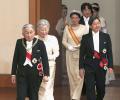
The emperor has no political power, yet he enjoys a unique place in Japanese society, notes Dr Rajaram Panda.

'If Indian armed forces entered Pakistan and succeeded in inflicting major damage on the Pakistani army and occupied territory in the Pakistani heartland, there is reason to think the Pakistani military would use some nuclear weapons against the incoming Indian forces to compel India to stop.'

India on Monday got the backing of Switzerland in its bid to become a member of the Nuclear Suppliers Group.
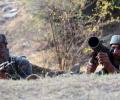
The current trans-LoC operations is a trailer projected to the Deep State that India can throw caution to the winds and calibrate its response.
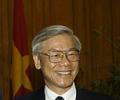
India-Vietnam relationship has its own imperatives and dynamism. In India's look east policy Vietnam has been the major pivot, at least in terms of security and strategic imperatives, says Rup Narayan Das.
 © 2026 Rediff.com - Advertise with us - Disclaimer - Privacy Policy - Sitemap - Feedback - About us - Terms of use - Grievances